

What Is a Period, and How Do You Calculate Your Cycle?
If you’ve ever wondered what’s actually happening during your menstrual cycle — or why your period shows up on a different day every month — you’re in the right place.
In short
- A period is the bleeding that happens when your uterus sheds its lining, usually for 3 to 7 days. Its first day is Day 1 of a new cycle.
- Cycle length is counted from Day 1 of one period to Day 1 of the next. 21 to 35 days is the usual range for adults.
- To predict your next period, track 3 to 6 cycles, work out the average, and count forward from your last Day 1.
- Ovulation usually comes about 14 days before your next period. These dates are estimates and are not birth control.
This guide is for women and anyone who gets periods, at any age — whether you just got your first period or you’ve been tracking yours for years and still feel confused by the numbers.
Here’s what we’ll walk through together:
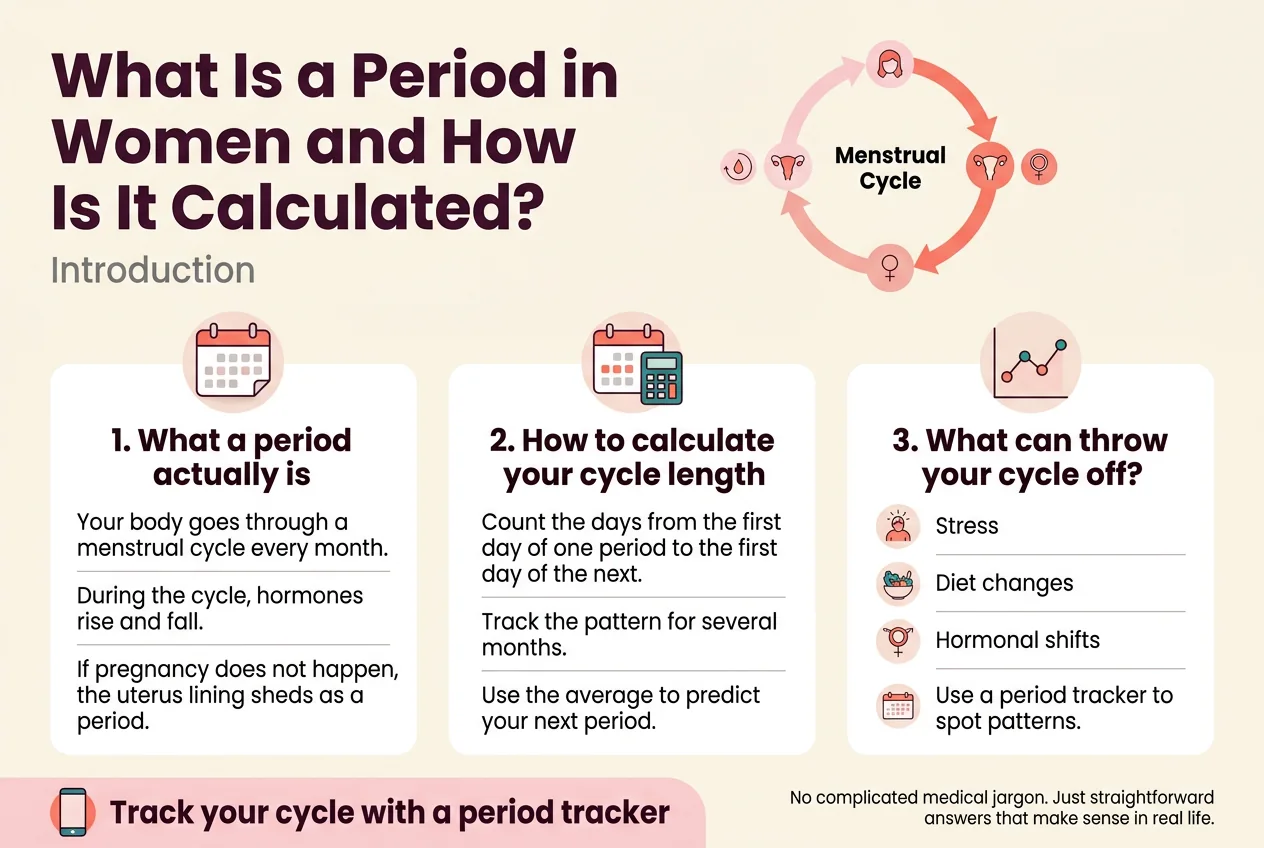
- What a period actually is and what your body is doing during each phase of the menstrual cycle
- How to calculate your cycle length so you stop guessing when your next period will arrive
- What throws your cycle off — stress, diet, hormones — and how to spot patterns using a period tracker
No complicated medical jargon. Just straightforward answers that actually make sense in real life.
Understanding the Menstrual Cycle
What a Period Actually Is and Why It Happens
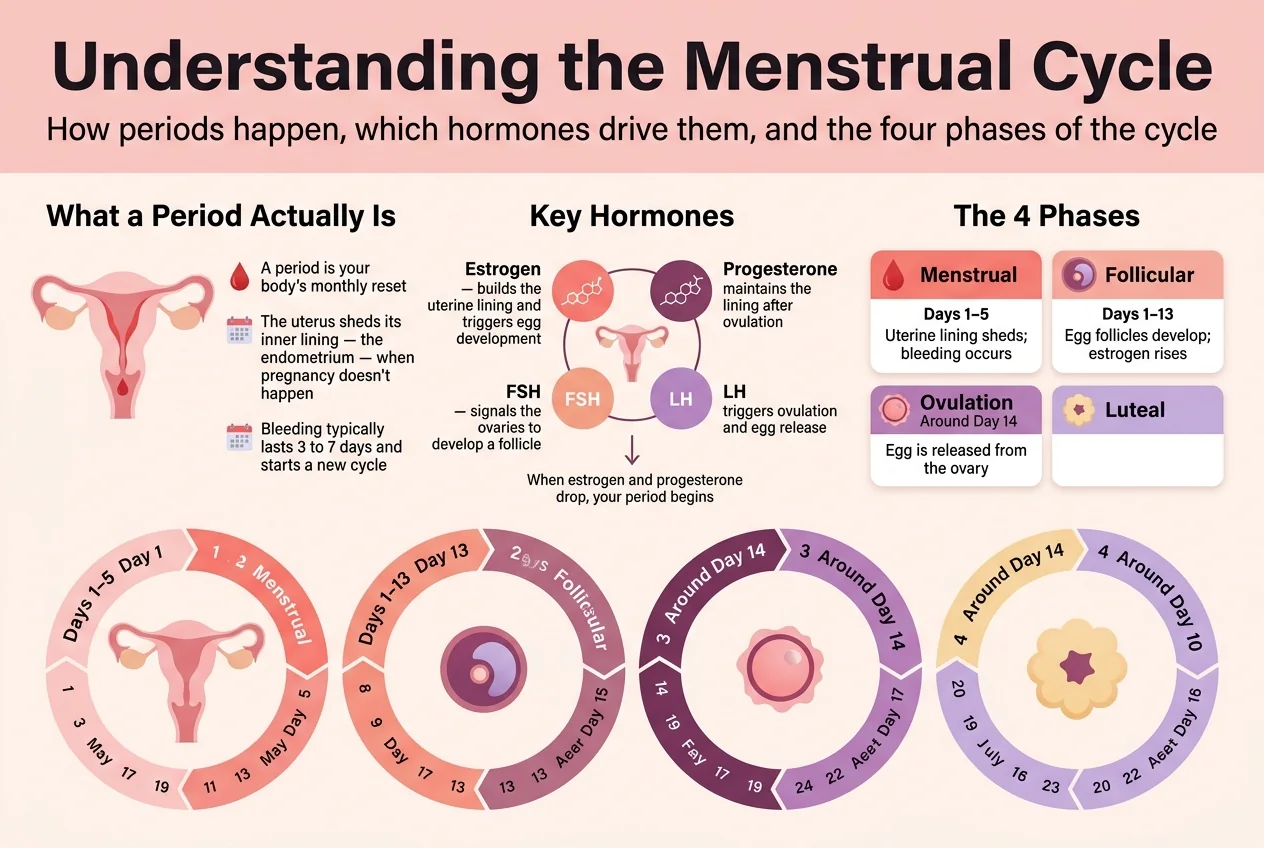
A period is your body’s monthly reset. When a pregnancy doesn’t happen, your uterus sheds its inner lining — the endometrium — along with a small amount of blood. This bleeding typically lasts between 3 to 7 days and marks the start of a brand new cycle.
Your body does this every single month as part of its natural preparation for a possible pregnancy. When that doesn’t happen, it clears the slate and starts over.
Key Hormones That Drive Your Cycle
Four main hormones work together behind the scenes:
- Estrogen – builds up the uterine lining and rises as your egg follicles develop
- Progesterone – maintains the lining after ovulation, preparing it for a fertilized egg
- FSH (Follicle-Stimulating Hormone) – signals your ovaries to develop a follicle containing an egg
- LH (Luteinizing Hormone) – triggers the release of that egg (ovulation)
When estrogen and progesterone drop at the end of the cycle, your period begins.
The Four Phases of the Menstrual Cycle
| Phase | When It Happens | What’s Going On |
|---|---|---|
| Menstrual | Days 1–5 | Uterine lining sheds; bleeding occurs |
| Follicular | Days 1–13 (starts with your period) | Egg follicles develop; estrogen rises |
| Ovulation | Around Day 14 | Egg is released from the ovary |
| Luteal | Days 15–28 | Body prepares for pregnancy; PMS may appear |
These days assume a 28-day cycle. The phases overlap, and timing shifts based on your unique cycle length, so treat the numbers as a guide, not a rule.
How the Uterus Prepares and Sheds Each Month
After your period ends, rising estrogen signals the uterus to rebuild its lining — thickening it to create a nourishing environment for a potential embryo.
After ovulation, progesterone takes over and makes that lining even more receptive. If no fertilized egg implants, both estrogen and progesterone levels fall sharply, usually about 12–14 days after ovulation.
That hormonal drop is the trigger. Blood vessels in the lining constrict, the tissue breaks down, and the shedding begins — starting your next period and resetting the entire cycle.
Common Period Symptoms and What They Mean
Physical Symptoms to Expect Before and During Your Period
Your body gives you plenty of signals before and during your period. Knowing what’s normal helps you stay prepared.
Before your period (PMS phase):
- Bloating and water retention
- Breast tenderness or swelling
- Headaches or mild migraines
- Fatigue and low energy
- Acne breakouts, especially around the chin and jaw
- Food cravings, particularly for sweets or salty snacks
During your period:
- Cramping (dysmenorrhea) in the lower abdomen or back
- Heavy or light bleeding depending on your cycle
- Nausea or loose stools caused by prostaglandins
- Dizziness, especially on heavier flow days
Cramps happen because your uterus contracts to shed its lining. Some women barely notice them; others find them debilitating. Both are valid experiences.
Emotional and Hormonal Changes Throughout the Cycle
Your hormones — estrogen and progesterone — shift dramatically across four phases. These shifts directly affect your mood and energy.
| Cycle Phase | Hormone Activity | How You Feel |
|---|---|---|
| Menstrual (Days 1–5) | Low estrogen & progesterone | Tired, introspective |
| Follicular (after your period, up to Day 13) | Rising estrogen | Energetic, positive, focused |
| Ovulation (Day 14) | Estrogen peaks | Confident, social, high energy |
| Luteal (Days 15–28) | Progesterone rises, then drops | Anxious, irritable, emotional |
The drop in progesterone right before your period is the main driver behind mood swings, irritability, and that “I want to cry but I don’t know why” feeling. It’s biology, not weakness.
When Symptoms Signal a Bigger Health Concern
Most period symptoms are manageable, but some are worth paying attention to.
Talk to a doctor if you notice:
- Cramps so severe they stop you from daily activities
- Bleeding that soaks through a pad or tampon every hour for several hours
- Periods that suddenly become much heavier or longer than usual
- Spotting between periods regularly
- Cycles shorter than 21 days or longer than 35 days
- Symptoms of anemia — extreme fatigue, pale skin, shortness of breath
These could point to conditions like endometriosis, PCOS (polycystic ovary syndrome), fibroids, or thyroid issues. Tracking your cycle consistently makes it much easier to spot unusual patterns early and share accurate details with your doctor.
How to Calculate Your Menstrual Cycle Length
Identifying Your Cycle Start and End Dates
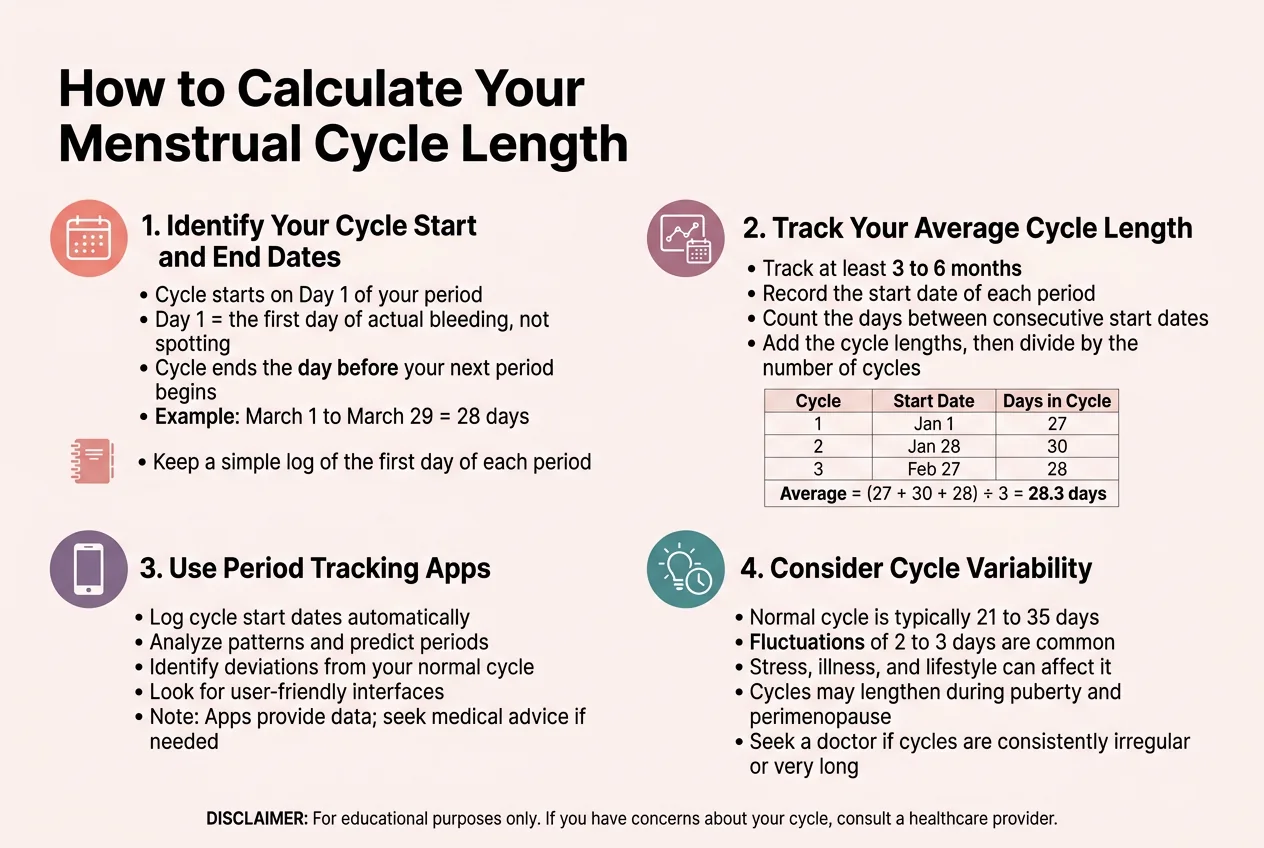
Your cycle starts on Day 1 of your period — the first day of actual bleeding, not spotting. It ends the day before your next period begins. So if your period starts on March 1st and your next one begins on March 29th, your cycle length is 28 days.
Keep a simple log — even a notebook works — marking the first day of each period. That single habit makes everything else much easier to figure out.
Tracking Your Average Cycle Length Over Multiple Months
One month of data won’t tell you much. Aim to track at least 3 to 6 months to get a reliable average.
Here’s how to calculate it:
- Record the start date of each period
- Count the days between consecutive start dates
- Add those numbers together, then divide by how many cycles you tracked
Example:
| Cycle | Start Date | Days in Cycle |
|---|---|---|
| 1 | Jan 1 | 27 |
| 2 | Jan 28 | 30 |
| 3 | Feb 27 | 28 |
Average = (27 + 30 + 28) ÷ 3 = 28.3 days
Using Period Tracking Apps for Accurate Results
Manual tracking is great, but apps make it way easier — especially when life gets busy. A tool like the Period Tracker on Khohari lets you log your cycle start dates, tracks patterns automatically, and even predicts your next period based on your personal history.
Apps are especially helpful because they:
- Remember your data so you don’t have to
- Flag irregular patterns you might miss on your own
- Factor in things like cycle length variations month to month
The more consistently you log, the smarter the predictions get.
Understanding the Difference Between Cycle Length and Period Duration
These two are easy to mix up:
| Term | What It Means | Typical Range |
|---|---|---|
| Cycle Length | Day 1 of one period to Day 1 of the next | 21–35 days |
| Period Duration | How many days you actually bleed | 2–7 days |
Your cycle can be 28 days long while your actual period only lasts 4 days — both are completely normal. Cycle length measures the whole hormonal loop; period duration is just the bleeding part of that loop.
Factors That Affect Your Cycle Regularity
How Age and Life Stage Impact Your Period
Your cycle changes throughout your life — and that’s completely normal.
Pregnancy and breastfeeding also pause your cycle temporarily. If your period is late and you think you may be pregnant, the Pregnancy Due Date Calculator can estimate a due date from the first day of your last period.
The Role of Stress, Diet, and Exercise on Cycle Health
Your lifestyle has a direct line to your hormones.
- StressRaises cortisol, which can suppress ovulation and delay your period
- Undereating or rapid weight lossSignals the body to shut down non-essential functions — including your cycle
- Intense exerciseThink marathon training: it can cause missed periods, known as exercise-induced amenorrhea
- High body fatCan increase estrogen, leading to heavier or irregular periods
Small, consistent habits matter more than drastic changes. If you are not sure whether your weight or your daily intake is in a healthy range, the BMI Calculator and the Calorie Calculator are a starting point. They are estimates, not a diagnosis (see what each of those numbers means).
Medical Conditions That Cause Irregular Periods
Some irregular cycles have a medical root cause worth exploring:
| Condition | How It Affects Your Period |
|---|---|
| PCOS (polycystic ovary syndrome) | Infrequent or absent periods due to hormonal imbalance |
| Thyroid disorders | Both hypo and hyperthyroidism disrupt cycle regularity |
| Endometriosis | Painful, heavy, or irregular bleeding |
| Uterine fibroids/polyps | Heavy bleeding or spotting between periods |
| Premature ovarian insufficiency | Early irregular or missed periods before age 40 |
Medications and Their Effect on Your Menstrual Cycle
Several common medications can change your cycle:
- Hormonal contraceptives (pills, IUDs, injections) — may lighten, stop, or regulate periods
- Some antipsychotics and a few antidepressants — can raise prolactin levels, disrupting ovulation
- Blood thinners — may cause heavier bleeding
- Chemotherapy drugs — often cause temporary or permanent cycle changes
- Steroids — can suppress ovulation with prolonged use
Always check with your doctor if you notice changes after starting a new medication.
When to Seek Medical Advice About an Irregular Cycle
Track your cycle regularly so patterns are easy to spot. Talk to a doctor if you notice:
- No period for 3+ months (and you’re not pregnant)
- Bleeding that lasts longer than 7 days
- Cycles shorter than 21 days or longer than 35 days
- Severe pain that disrupts daily life
- Spotting between periods or after sex
Early attention saves a lot of guesswork later.
Predicting Your Next Period with Confidence
How to Use Past Cycle Data to Forecast Future Periods
Tracking your past cycles is the most reliable way to predict when your next period will arrive. Here’s a simple approach:
- Collect at least 3 months of data — note the start date of each period
- Calculate your average cycle length — add up all cycle lengths, then divide by the number of cycles tracked
- Count forward from your last period — apply your average cycle length to predict the next start date
For example, if your last three cycles were 28, 30, and 26 days, your average is 28 days. Count 28 days from the first day of your last period, and that’s your predicted start date.
Tools like the Khohari Period Tracker do all this math automatically, saving you the mental gymnastics every month.
Understanding Ovulation Windows and Fertile Days
Knowing your ovulation window helps you predict your period and understand your fertility. Ovulation typically happens about 14 days before your next expected period, not necessarily the middle of your cycle.
| Cycle Length | Likely Ovulation Day |
|---|---|
| 28 days | Day 14 |
| 30 days | Day 16 |
| 32 days | Day 18 |
| 26 days | Day 12 |
Your fertile window spans roughly 5 days before ovulation plus the day of ovulation itself. Once ovulation passes, your period will usually follow in 12–16 days. If it doesn’t, that’s worth paying attention to. To see your likely dates worked out from your own last period and cycle length, try the Ovulation Calculator.
This is not birth control. Counting days and predicting ovulation only give estimates. Ovulation can shift from one month to the next, and sperm can survive in the body for up to five days, so do not rely on these dates to avoid pregnancy. Ask a doctor or pharmacist about contraception that suits you.
Adjusting Predictions for Irregular Cycles
Irregular cycles make prediction trickier, but not impossible. A few practical adjustments help:
- Use a wider prediction window — instead of one date, estimate a 5-day range
- Track patterns, not just averages — notice if your cycle is consistently short during stressful months or longer in summer
- Watch for physical cues — bloating, breast tenderness, and mood shifts often signal your period is 3–5 days away
- Log lifestyle factors — stress, sleep changes, and illness all shift your cycle
If your cycles vary by more than 7–9 days regularly, talking to a healthcare provider is a smart move. Irregular cycles can sometimes point to underlying conditions like PCOS or thyroid imbalances that are very manageable once identified.
Conclusion
Your menstrual cycle is a natural part of life, and understanding how it works can make a huge difference in how you feel day to day. From recognizing common symptoms to knowing what affects your cycle’s regularity, being informed helps you stay in tune with your body and spot any changes that might need attention.
Tracking your period doesn’t have to be complicated. Whether you’re counting days on a calendar or using an app, knowing your cycle length gives you the power to plan ahead and feel more confident about what’s coming next. If your cycle feels irregular or something just doesn’t seem right, don’t hesitate to reach out to your doctor — your health always comes first.
Frequently asked questions
How many days is a normal period?
Is a 21-day or a 35-day cycle normal?
How do I calculate the date of my next period?
When does ovulation happen?
Can I get pregnant during my period?
Why is my period late?
Sources and further reading
- NHS: Periods
- Office on Women’s Health (US): Your menstrual cycle
- World Health Organization: Menstrual health
- ACOG: Your first period
Important
This guide and the tools linked in it give general information, not a diagnosis or medical advice. Every body is different, and cycle predictions are estimates; they are not a method of contraception. If something worries you, or you are pregnant or may be, talk to a doctor.
Track your cycle
Log the first day of each period and see your average cycle length and your next expected date. It runs in your browser, nothing is uploaded.
Open Period TrackerMore guides
- BMI, BMR and TDEE: what each number means and which one to use
- How to reduce a photo to 20 KB, 50 KB or 100 KB for an online form
- How to turn photos into one PDF (and keep it small)
- How to password-protect a PDF, or unlock one you own
- Split, extract, remove or rearrange PDF pages: which one do you need?
- How to sign a PDF without printing, signing and scanning it